
Why Dental Clinic Websites in 2026 Often Fail to Bring New Patients — Even With Great Design
A few years ago, a well-built dental website could genuinely become the main source of new patients for a clinic. If the site looked modern, loaded reasonably fast, and had a bit of SEO behind it, it could generate a steady flow of calls and appointment requests.
In 2026, things work very differently.
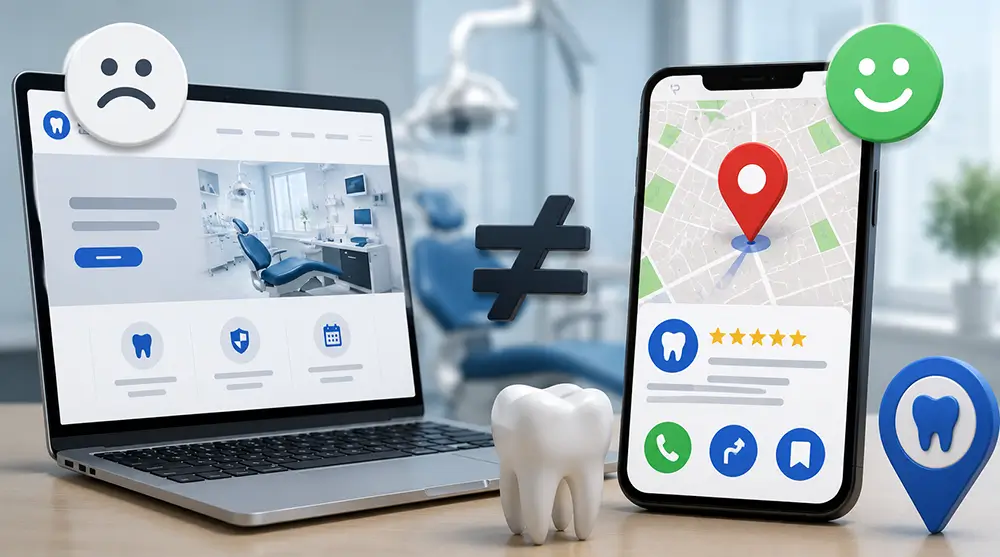
And many clinic owners don’t immediately notice the shift. They invest in a polished redesign, expensive visuals, animations, and modern UI trends — yet organic traffic barely grows, and the number of new patient inquiries remains surprisingly low.
At the same time, their Google Business Profile may receive thousands of monthly views while the website itself struggles to attract meaningful traffic.
This isn’t necessarily a sign of poor SEO or weak design.
The reality is simpler: local search behavior has changed dramatically.
AI-driven search results, Google Maps dominance, mobile-first behavior, and zero-click search experiences have fundamentally changed how people find local services — especially dental clinics.
The Website Is No Longer the First Touchpoint
One question I’ve heard repeatedly from dental clinic owners over the last couple of years is:
“We invested in a professional website. Why isn’t it bringing patients?”
The uncomfortable answer is that the website itself is no longer the center of the patient acquisition process.
Today, people discover dental clinics through:
- Google Maps;
- local recommendations;
- Instagram;
- TikTok;
- online reviews;
- paid local ads;
- mobile navigation apps.
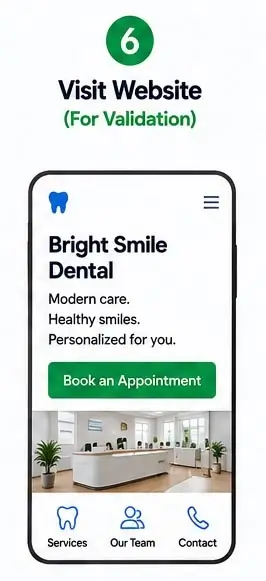
In many cases, the website is opened only after the patient has already shortlisted the clinic.
Its role has changed.
A dental website in 2026 is less about generating raw traffic and more about confirming trust.
And that changes everything.
Dentistry Is an Ultra-Local Business
Unlike software agencies, e-commerce stores, or online services, dentistry remains highly location-dependent.
Most patients search for clinics:
- near home;
- near work;
- inside their district;
- close to convenient transportation routes.
Even in large cities, people rarely travel across town for routine dental procedures if they can find a clinic nearby with:
- good reviews;
- decent reputation;
- reasonable pricing;
- trustworthy presentation.
You can see this behavior everywhere. People are no longer sitting at a desktop computer comparing 15 clinic websites in detail.
The modern workflow is much simpler:
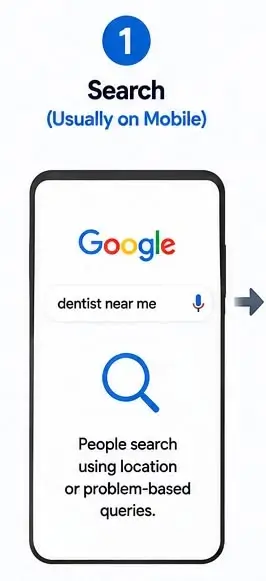
- open Google Maps;
- check nearby clinics;
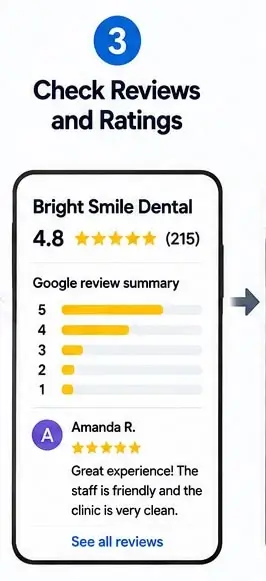
- scan ratings;
- look at photos;
- read a few reviews;
- call or save for later.
In this process, the website becomes part of the validation stage — not necessarily the discovery stage.
That’s one of the main reasons why Google Maps often drives more real patient inquiries than organic search traffic itself.
Interestingly, many local businesses still underestimate how difficult visibility in Google Maps has become. Even companies with active websites and years of experience sometimes struggle to appear consistently in local results. We discussed some of the most common reasons in our article about why businesses fail to appear properly in Google Maps.
How Patients Search for Dental Clinics Today
A typical search journey used to look like this:
Google → Website → Call → Appointment
Today, it often looks more like this:
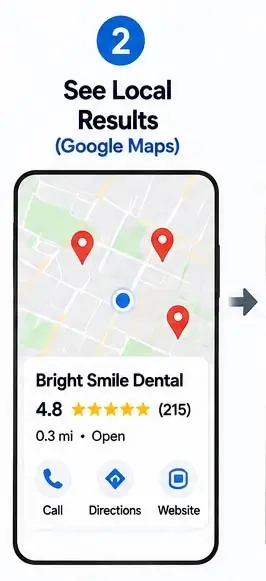
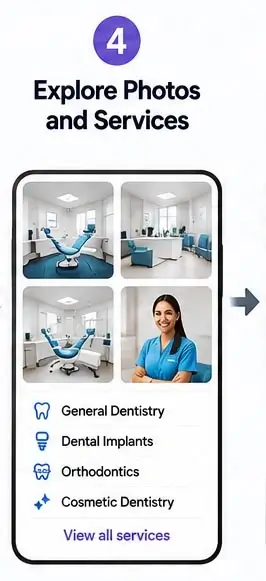
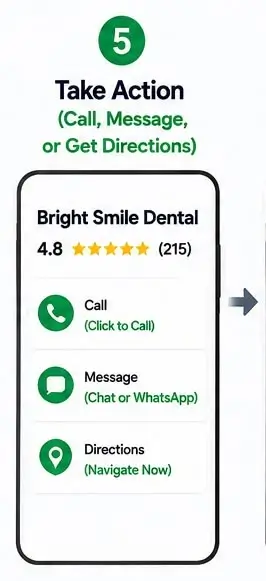
Google Maps → Reviews → Photos → Call → Website → Appointment
Sometimes the website is barely involved at all.
Especially on mobile devices.
Before even visiting the website, users already see:
- ratings;
- photos;
- directions;
- phone numbers;
- working hours;
- reviews;
- clinic location.
For many local searches, that information alone is enough to trigger the first contact.
Interestingly, many clinic owners still underestimate this shift. They may spend thousands of dollars redesigning a website while leaving their Google Business Profile outdated for years.
Meanwhile, the Google profile is often the first thing potential patients actually interact with.
Why Beautiful Design Alone No Longer Works
One of the biggest misconceptions in modern dental marketing is the belief that visual polish automatically creates trust.
In reality, many modern dental websites have become too polished.
Over the last few years, countless clinics adopted the same “premium” visual formula:
- fullscreen video backgrounds;
- heavy animations;
- cinematic transitions;
- stock photos of smiling models;
- AI-generated imagery;
- generic marketing slogans.
The result is visually impressive — but emotionally empty.
Patients have become surprisingly good at recognizing template-driven websites.
And in healthcare, authenticity matters far more than visual effects.
Especially in local markets where decisions are emotional and fast.
Many of these issues are not limited to dental websites. Overloaded layouts, weak structure, excessive animations, and unclear messaging remain some of the most common reasons modern business websites fail to convert visitors into customers. We explored these problems further in our article about common mistakes that cause websites to lose potential clients.
The Problem With “Luxury Template” Websites
Another issue rarely discussed in web design circles is how similar modern dental websites have become.
The same layouts. The same colors. The same stock photography. The same “personalized approach” messaging.
After opening several clinic websites in a row, users stop remembering any of them.
Ironically, many expensive websites feel less trustworthy than simpler ones.
Because people are not looking for cinematic web experiences when searching for a dentist.
They are looking for reassurance.
What Actually Builds Trust in Healthcare Websites
Patients rarely analyze design professionally.
They evaluate websites emotionally and subconsciously.
Most users are simply trying to answer a few basic questions:
- Is this a real clinic?
- Are there real doctors here?
- Does this place feel safe?
- Can I trust them?
- Is booking an appointment going to be easy?
This is where many “perfect” websites fail.
Instead of authenticity, they present:
- stock smiles;
- generic copywriting;
- faceless imagery;
- vague promises;
- no real staff presence;
- no real clinic atmosphere;
- no evidence of expertise.
As a result, the website may look modern — but still fail to create trust.
Google Maps Often Matters More Than SEO
For many local businesses, Google Maps now generates more real leads than traditional organic rankings.
This is especially true for:
- dental clinics;
- beauty salons;
- private medical practices;
- local service businesses;
- repair companies.
The reason is simple: Google is trying to shorten the path between search and action.
When users search for:
- “dentist near me”;
- “teeth cleaning”;
- “dental implants”;
- “emergency dentist”.
Google immediately displays:
- ratings;
- reviews;
- photos;
- phone buttons;
- directions;
- operating hours.
And often that’s enough to generate a call.
This is why many clinics today experience a strange situation: their Google Business Profile receives massive visibility while their website traffic remains relatively modest.
That’s not necessarily failure. It’s simply how local search now works.
SEO for Dental Clinics Has Become More Difficult
Another major shift is the rise of AI-driven search experiences.
Google increasingly keeps users inside its own ecosystem through:
- AI Overviews;
- featured answers;
- local packs;
- zero-click search;
- integrated maps.
A few years ago, informational searches could still generate meaningful website traffic:
- “How long do dental implants last?”
- “How painful are braces?”
- “What to do if a tooth hurts?”
Today, much of that information is answered directly inside search results.
Especially on mobile.
As a result, even well-written blog content may no longer generate the same level of traffic it once did.
And that’s another reason why a beautiful website alone is no longer enough.
This shift is not unique to dentistry. Many small local businesses are facing the same challenge: traditional SEO tactics no longer work as predictably as they did a few years ago. Modern local SEO increasingly depends on trust signals, entity consistency, local relevance, and Google Business Profile optimization. We covered this topic in more detail in our article about SEO campaigns for small businesses.
The Biggest Mistake Dental Websites Still Make
One of the most common problems is trying to make the website “about everything.”
In practice, this usually means:
- one generic services page;
- vague content;
- weak page structure;
- no dedicated landing pages;
- minimal specialization.
As a result, Google struggles to understand which pages relate to:
- dental implants;
- braces;
- pediatric dentistry;
- root canal treatment;
- cosmetic procedures.
And users fail to quickly find answers relevant to their specific problem.
In 2026, clarity often outperforms visual sophistication.
A Dental Website Is Now a Conversion Tool
This is perhaps the most important shift.
Many clinic owners still evaluate websites as standalone traffic sources.
But for local businesses, websites increasingly function as trust infrastructure.
Patients may arrive from:
- Google Maps;
- recommendations;
- Instagram;
- paid ads;
- social media;
- word of mouth.
And the website’s job becomes:
- validating professionalism;
- explaining services;
- presenting doctors;
- reducing uncertainty;
- making the clinic feel real.
In other words: the website now supports conversion rather than drives discovery.
What Actually Works in 2026
Interestingly, the clinics that perform best online are often not the ones with the most visually impressive websites. They are usually the ones that feel the most transparent, practical, and easy to trust. After reviewing many successful local clinic websites, several patterns appear consistently.
Real Photography
Not AI-generated visuals. Not stock models.
Real:
- doctors;
- treatment rooms;
- equipment;
- clinic interiors.
Even imperfect authentic photos usually outperform generic “premium” imagery.
Simplicity
Patients don’t want complexity.
They want to quickly find:
- services;
- pricing;
- doctors;
- contact details;
- appointment forms;
- clinic location.
Strong Mobile Experience
For many local businesses, mobile traffic already exceeds 80%.
If the site:
- loads slowly;
- jumps while loading;
- uses intrusive popups;
- has tiny text;
- feels unstable;
conversion rates drop immediately.
Speed
Many modern dental websites remain overloaded with:
- heavy videos;
- animations;
- oversized images;
- unnecessary JavaScript effects.
These sites may impress during presentations but perform poorly in real-world mobile usage.
Especially on slower mobile connections.
Why Simpler Websites Sometimes Convert Better
This is an uncomfortable truth for many agencies.
But simple websites are often:
- faster;
- clearer;
- easier to trust;
- less distracting.
Patients are not necessarily looking for “award-winning design.”
Especially in healthcare. This is especially noticeable in local healthcare niches, where users make decisions quickly and emotionally rather than analytically.
They are looking for:
- clarity;
- confidence;
- comfort;
- safety.
That’s why some very simple clinic websites continue to generate strong patient flow year after year.
How AI Changed Local Search
AI didn’t kill websites.
But it changed their role.
Google increasingly:
- answers questions directly;
- reduces clicks;
- prioritizes local intent;
- expands Google Business Profiles;
- keeps users inside search results.
As a result, the old model:
SEO → Traffic → Website → Client
is becoming less effective for local businesses.
Especially in highly local industries like dentistry.
What a Dental Website Should Be in 2026
A modern dental website doesn’t need to be flashy. Most successful local clinic websites today are surprisingly straightforward. They focus less on visual effects and more on reducing friction and uncertainty for potential patients.
It needs to be:
- fast;
- trustworthy;
- mobile-friendly;
- clear;
- authentic;
- easy to navigate.
Most importantly, it should feel real within the first few seconds.
Because in today’s local search environment, trust matters more than visual perfection.
Final Thoughts
In 2026, dental clinic websites are no longer the primary source of patient acquisition.
For many clinics, the majority of new inquiries now come from:
- Google Maps;
- local search;
- recommendations;
- social media;
- paid advertising.
And that’s completely normal.
But websites still remain critically important.
Not as traffic machines — but as trust-building tools.
The biggest problem with many dental websites today is not that they look outdated.
It’s that they were built for an internet that no longer exists.
