
Google Ignores Your Hreflang? 10 Reasons Your English Page Is Not Ranking in the US
Launching an English version of a website often feels like a major milestone.
The pages are translated, language switching works correctly, and hreflang tags have been added according to Google’s recommendations. Everything appears technically sound. Yet months later, many website owners discover an uncomfortable reality: their English pages receive little to no organic traffic from the United States.
At first glance, the obvious suspect is hreflang.
After all, if the problem started after launching a multilingual website, the issue must be somewhere in the multilingual setup, right?
Not necessarily.
Over the years, we have reviewed multilingual websites built on WordPress, WooCommerce, custom CMS platforms, and enterprise systems. In many cases, hreflang was implemented correctly. Google understood the language relationships between pages. The problem was somewhere else.
This is an important distinction because hreflang is often misunderstood.
What Hreflang Actually Does (and What It Doesn’t)
Many website owners assume that hreflang helps pages rank better in a specific country.
It doesn’t.
Hreflang is not a ranking factor.
Its purpose is to help Google understand which language or regional version of a page should be shown to a particular user. It helps Google choose between alternatives, but it does not make any version stronger.
Think of hreflang as a navigation signal rather than an authority signal.
If an English page has weak content, poor localization, no backlinks, conflicting canonical tags, or limited trust signals, correct hreflang implementation alone will not solve those problems.
That is why some multilingual websites see almost no improvement after adding hreflang, while others perform well even with imperfect implementations.
The difference usually lies elsewhere.
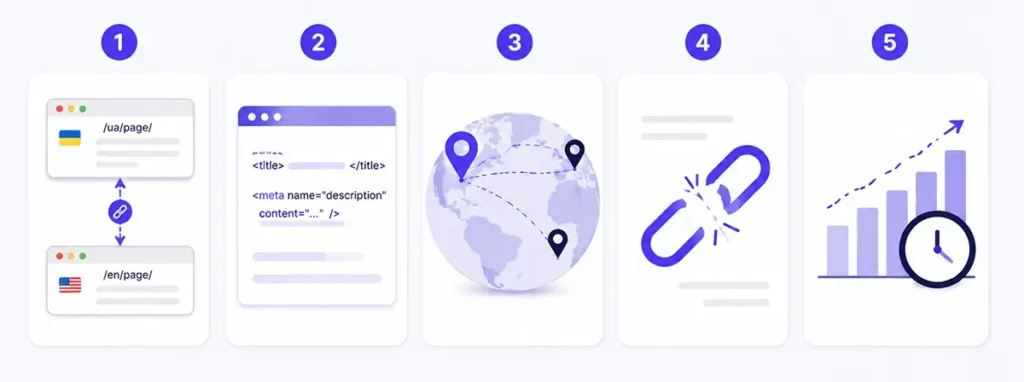
Reason #1. Canonical Tags Override Your Hreflang Signals
One of the most common issues we encounter involves a conflict between canonical tags and hreflang annotations.
Imagine the following scenario:
- a Ukrainian page;
- an English version of that page;
- properly configured hreflang tags connecting both versions.
Everything seems correct.
However, the English page contains a canonical tag pointing to the Ukrainian URL.
At that moment, two different signals are being sent to Google.
The hreflang annotation says:
This is an alternative language version.
The canonical tag says:
This is not the preferred page.
When those signals conflict, Google will typically place more weight on the canonical tag.
As a result, the English page may struggle to gain visibility because the page itself suggests that another URL should be treated as primary.
The safest approach is usually straightforward:
- the Ukrainian page should have a self-referencing canonical;
- the English page should have a self-referencing canonical;
- hreflang should connect the two versions.
This allows Google to understand that both pages are legitimate alternatives rather than duplicates competing for the same indexation signals.
Interestingly, even correctly configured canonical tags do not guarantee Google’s compliance. Google may occasionally choose a different canonical page than the one specified by the site owner. That is why canonical tags and hreflang should always be reviewed together during international SEO audits.
This is not merely a theoretical issue. We have already covered situations where Google selected a different canonical page than the one explicitly defined by the website owner. If you are dealing with multilingual SEO, understanding how Google interprets canonical signals is just as important as configuring hreflang correctly. Read more about Google’s canonical page selection.
Reason #2. Your English Page Is a Translation, Not a Localization
Translation and localization are often treated as the same thing.
They are not.
Modern AI-powered translation tools have made it possible to create English versions of websites in a matter of hours. Grammar has improved dramatically. Obvious translation mistakes have become less common.
Yet many translated pages still fail to resonate with their target audience.
Why?
Because translation changes language.
Localization changes context.
An English page targeting the US market should feel like it was created for US visitors.
Many localization problems originate long before content is translated. In fact, they often appear during the planning stage when target markets, languages, and customer expectations have not been clearly defined. Asking the right questions before development begins can prevent many of these issues later. Here are twelve questions we recommend discussing before starting a web project.
Unfortunately, many multilingual websites still contain:
- local references unfamiliar to international users;
- pricing in domestic currency without context;
- region-specific examples;
- direct translations of headlines that sound unnatural in English;
- calls to action designed for a different market.
To a website owner, the page appears fully translated.
To a US visitor, it often feels foreign.
Google continues to improve its understanding of content quality, audience intent, and user satisfaction. While no one outside Google knows exactly how these signals are evaluated, localization increasingly appears to play a role in how relevant a page feels to its intended audience.
A page written for local users and merely translated into English is not always competitive in US search results.
The difference may be subtle for humans, but it becomes significant when competing against businesses that created their content specifically for the American market.
Reason #3. Your Meta Titles and Descriptions Are Not Translated
This issue is surprisingly common.
The page itself is translated.
The URL is translated.
The content is translated.
The hreflang implementation is correct.
But the SEO metadata remains unchanged.
We often see situations where English pages still use titles and descriptions originally created for another language version. Sometimes this happens because a multilingual plugin does not support metadata translation in its free version. Sometimes the feature simply goes unnoticed during setup.
The result looks something like this:
English page URL:
/en/services/ecommerce-development/
Meta title:
Website Development in Kyiv | Company Name
Meta description:
Professional website development services in Ukraine.
Technically, the page is English.
But the metadata still targets a completely different audience.
This creates mixed signals for search engines and users alike.
When auditing multilingual websites, always verify:
- page titles;
- meta descriptions;
- Open Graph titles;
- Open Graph descriptions;
- archive and category metadata;
- service page metadata.
Many site owners spend weeks improving content while overlooking the metadata that Google often sees first.
Reason #4. Your English Pages Have No Link Equity
This is one of the least discussed problems in multilingual SEO.
A website owner launches an English section, translates the most important pages, submits a sitemap, and waits for rankings.
Months later, nothing significant happens.
The technical setup may be perfectly fine. The content may even be reasonably good.
But there is a simple question worth asking:
Who is actually linking to those English pages?
In many cases, the answer is nobody.
The website may have accumulated backlinks over several years, but most of them point to the homepage, blog posts in the original language, or legacy content that has already established authority.
The English section often starts from scratch.
Google can clearly see that difference.
A Ukrainian service page with years of internal links, backlinks, and engagement signals may have considerably more authority than its freshly translated English counterpart.
The result is predictable.
The original language version continues to perform well while the English version struggles to gain visibility.
This becomes even more noticeable in competitive markets such as web development, SaaS, cybersecurity, healthcare, or legal services, where many competing websites have spent years building authority in English.
Correct hreflang implementation cannot compensate for a lack of trust signals.
Reason #5. Internal Linking Still Favors the Original Language
External links are not the only issue.
Internal linking often tells a similar story.
During audits, we frequently see websites where the primary language section has evolved naturally for years. New articles link to service pages. Service pages link to case studies. Case studies link to related resources.
Everything is connected.
The English section, however, is often much smaller.
A translated service page may receive only a handful of internal links. Some pages can only be reached through the language switcher.
Technically, they exist.
Practically, they remain isolated.
From Google’s perspective, internal linking is one of the clearest ways a website communicates importance.
If most internal authority flows toward the original language section, it is not surprising when search visibility follows the same pattern.
For that reason, multilingual SEO should not stop at translation.
The English section needs its own content ecosystem.
English articles should link to English services.
English case studies should support English landing pages.
The goal is not simply to translate pages but to build a structure that makes sense independently of the original language.
Reason #6. Google Considers the Pages Too Similar
Website owners sometimes assume that having an English version automatically creates unique content.
That is not always the case.
Imagine a service page containing 300 words.
Now imagine translating those same 300 words into English.
From a user’s perspective, the pages are different languages.
From Google’s perspective, they may still provide very similar value.
This becomes especially problematic when pages are short, generic, or heavily template-driven.
A service page with a few paragraphs, a contact form, and a stock image rarely provides enough depth to establish strong relevance in a competitive market.
The issue is not duplication.
The issue is usefulness.
Google is not deciding whether the English page is different from the Ukrainian page.
Google is deciding whether the English page deserves visibility compared to thousands of competing English pages.
That is a much tougher comparison.
Reason #7. Hreflang Implementation Errors Still Happen
Sometimes the problem really is hreflang.
Not often.
But often enough.
The most common mistakes include:
- incorrect language codes;
- missing reciprocal references;
- hreflang annotations pointing to redirected URLs;
- references to non-indexable pages;
- inconsistencies between sitemap and HTML implementations.
One surprisingly frequent mistake involves language and country codes.
For example:
enrefers to English;en-USrefers to English for the United States;en-GBrefers to English for the United Kingdom.
Similarly, Ukrainian should use uk, not ua.
Small details like these can create confusion that is difficult to spot without a dedicated audit.
The good news is that technical hreflang issues are usually the easiest problems to fix.
The bad news is that fixing them does not automatically solve ranking problems.
Reason #8. Your English Section Has No Topical Authority
A single translated page rarely performs well on its own.
This is something many website owners discover the hard way.
They translate one service page.
Maybe two.
Perhaps a homepage and an about page.
Then they wait.
Unfortunately, Google tends to evaluate websites within a broader context.
If the original language section contains dozens of articles, guides, case studies, and service pages while the English section consists of only a few translated URLs, the imbalance becomes obvious.
One section demonstrates expertise.
The other merely exists.
Building topical authority in a second language requires more than translation.
It usually requires:
- supporting articles;
- practical guides;
- case studies;
- FAQs;
- resource pages;
- internal content clusters.
In other words, the English section must become a genuine knowledge base rather than a simplified copy of the original website.
The websites that perform best internationally tend to treat their English content as a separate publishing effort rather than an afterthought.
This is particularly important for eCommerce websites and service businesses entering international markets. Building authority usually requires more than translating a few pages. It involves creating supporting content, case studies, and topic clusters around the services you offer. Our WooCommerce store development case study demonstrates how detailed project documentation can support long-term content authority.
Reason #9. User Signals May Tell a Different Story
Even when a page starts receiving impressions, rankings are not guaranteed.
Users ultimately decide whether a page deserves attention.
Someone searches.
They click.
They visit the page.
And then something happens.
Or nothing happens.
If visitors quickly return to the search results because the content feels irrelevant, confusing, or disappointing, that behavior becomes part of the overall picture Google sees.
No one outside Google knows exactly how user signals are incorporated into ranking systems.
However, it is difficult to imagine that long-term user satisfaction plays no role.
This is another reason why localization matters.
A page may be technically correct while still failing to connect with its intended audience.
Reason #10. The English Section Is Simply Too New
Sometimes the least exciting explanation is the correct one.
The English section is new.
That is all.
There are no major technical issues.
No hreflang errors.
No indexing problems.
No hidden canonical conflicts.
Just a lack of history.
Many website owners expect immediate results after publishing English content.
That expectation is understandable.
The pages are live.
Google indexes them.
Everything appears ready.
Yet international SEO often moves more slowly than expected.
Google needs time to crawl, evaluate, compare, test, and understand where those pages fit within a competitive landscape.
A page can enter the index within hours and still require months before meaningful organic traffic appears.
That delay does not necessarily indicate a problem.
Sometimes it simply reflects the reality of building authority in a new market.
How to Audit a Multilingual Website When English Pages Are Not Ranking
When an English section struggles to gain visibility, many website owners immediately start looking for technical issues.
Sometimes they find one.
Often they find several.
But in our experience, the most effective audits follow a simple order.
Start with the fundamentals before diving into advanced SEO theories.
Check Canonical Tags First
Before reviewing hreflang annotations, make sure every language version has the correct canonical configuration.
- each language version should have a self-referencing canonical tag;
- canonical URLs should return a 200 status code;
- canonical tags should not point to another language version.
If canonical and hreflang send conflicting signals, Google will usually trust canonical more.
That makes this one of the most important areas to verify.
Review Hreflang Relationships
Once canonical tags are confirmed, review hreflang implementation.
Look for:
- missing reciprocal references;
- incorrect language codes;
- broken URLs;
- redirected URLs;
- non-indexable pages.
Many hreflang problems are surprisingly small.
A single incorrect code can invalidate an entire language relationship.
Verify Metadata for Every Language
Do not assume translated content means translated SEO metadata.
Check:
- title tags;
- meta descriptions;
- Open Graph tags;
- archive metadata;
- service page metadata.
Several multilingual plugins require additional configuration before metadata becomes translatable.
Review Internal Linking
Ask yourself:
- How many internal links point to English service pages?
- Do English blog posts support English landing pages?
- Can important pages be reached without using the language switcher?
Internal linking is one of the strongest signals of importance available to website owners.
Evaluate Content Beyond Translation
Try to view the page as someone from the target market.
Ask questions such as:
- Does this content feel local?
- Are the examples relevant?
- Are prices, measurements, and terminology appropriate?
- Does the page answer questions that potential customers in the US would actually ask?
Translation solves language barriers.
Localization solves relevance barriers.
Analyze Authority Signals
Finally, look at authority.
This includes:
- backlinks;
- brand mentions;
- topical coverage;
- supporting content;
- content clusters.
Many multilingual websites have a strong primary language section and a very weak English section.
From Google’s perspective, those sections may not carry the same level of expertise or trust.
A Realistic Expectation for International SEO
One of the biggest mistakes we see is expecting immediate results after launching an English version.
The pages go live.
The sitemap is submitted.
Google indexes the content.
And then the waiting begins.
International SEO rarely works that quickly.
Even technically perfect implementations need time.
Google must:
- crawl the pages;
- understand their purpose;
- compare them against competitors;
- evaluate user engagement;
- assess authority signals.
In highly competitive markets, that process can take months.
This is especially true for service-based businesses entering the US market for the first time.
Patience is not always an SEO strategy.
But in international SEO, it is often part of the process.
Final Thoughts
When an English page fails to rank in the United States, hreflang is usually the first thing people investigate.
Sometimes that is the right instinct.
More often, however, the problem lies elsewhere.
Canonical conflicts, untranslated metadata, weak internal linking, poor localization, limited authority, and unrealistic expectations can all have a greater impact on visibility than hreflang itself.
That does not mean hreflang is unimportant.
It simply means it should be viewed as one component of a larger international SEO strategy.
The websites that succeed in multilingual search are rarely the ones with the most perfect hreflang implementation.
They are usually the ones that combine technical accuracy with strong content, clear localization, and long-term authority building.
If your English pages are not ranking yet, the solution may not be hidden in your hreflang tags.
It may be hidden in the broader signals Google uses to determine whether your content deserves visibility in the first place.
