
Landing Page Development Service
A few years ago, a client came to us with a problem that sounded familiar.
Google Ads was running. People were visiting the website. The business was getting traffic every day.
Yet the number of inquiries was far below expectations.
At first, the assumption seemed obvious. Something must be wrong with the advertising campaign.
After taking a closer look, the situation turned out to be different.
The ads were doing their job.
The landing page wasn’t.
Over the years, we’ve seen similar situations more times than we can count. That’s probably why we no longer think of landing pages as standalone web pages. We see them as part of a larger lead generation system where advertising, trust, user experience, and business credibility all work together.
A well-designed page won’t magically solve every marketing problem. But it can make the difference between a visitor leaving after a few seconds and a visitor becoming a customer.
Landing page development starts from $500.
Not Every Business Needs a Landing Page
This might sound like a strange thing to say on a page about landing page development, but it’s true.
We’ve had conversations with business owners who were convinced they needed a landing page. After twenty minutes of discussion, it became clear that what they actually needed was a larger website.
If a company offers multiple services, plans to invest heavily in SEO, or expects to expand over the next few years, a single page can become limiting surprisingly quickly.
On the other hand, there are situations where a landing page makes perfect sense.
- Launching a new service.
- Testing a business idea.
- Running Google Ads.
- Promoting a seasonal offer.
- Entering a new market.
In those situations, keeping everything focused on one offer often works better than sending visitors through a large website.
The right solution depends on where the business is today and where it wants to be tomorrow.
If you are still choosing between a one-page website and a larger structure, you may also find our article on one-page website cost and development options useful. It explains when a simple page is enough and when it is better to think about a full website from the start.
Landing Page or Full Website?
Sometimes a focused landing page is enough. Sometimes it becomes clear from the first conversation that the business will quickly outgrow a single-page format.
| Landing Page | Full Website |
|---|---|
| One service or offer | Multiple services or business areas |
| Fast launch for Google Ads | Long-term SEO and content growth |
| Testing demand in a new market | Building brand authority over time |
| Lower initial investment | More room for scaling and structure |
Not sure which option fits your business? We can help you decide after a short discussion.
Why Some Pages Keep Generating Leads for Years
One thing we’ve learned over time is that successful landing pages are rarely the most complicated ones.
Some of the best-performing projects we’ve worked on looked surprisingly simple.
No fancy animations.
No unusual effects.
No endless scrolling filled with marketing buzzwords.
Just a clear offer, enough information to build trust, and an obvious next step.
That may sound almost too simple, but real users tend to appreciate clarity more than creativity.
One project that still comes to mind involved a locksmith business in the United States.
Building the website itself wasn’t particularly difficult. The unexpected part came afterward.
Before working with us, the client’s Google Business Profile had already been suspended. Because locksmith services are considered a high-risk category in many areas, every step required additional verification.
What we thought would take a few weeks ended up taking months.
There were documents to submit, ownership details to verify, conversations with support teams, and repeated reviews.
Looking back, the experience taught us something valuable.
A landing page doesn’t exist in isolation.
It needs to work together with advertising, local visibility, trust signals, and the overall credibility of the business.
When those pieces support each other, lead generation becomes much easier.
A Real Project That Taught Us a Lot
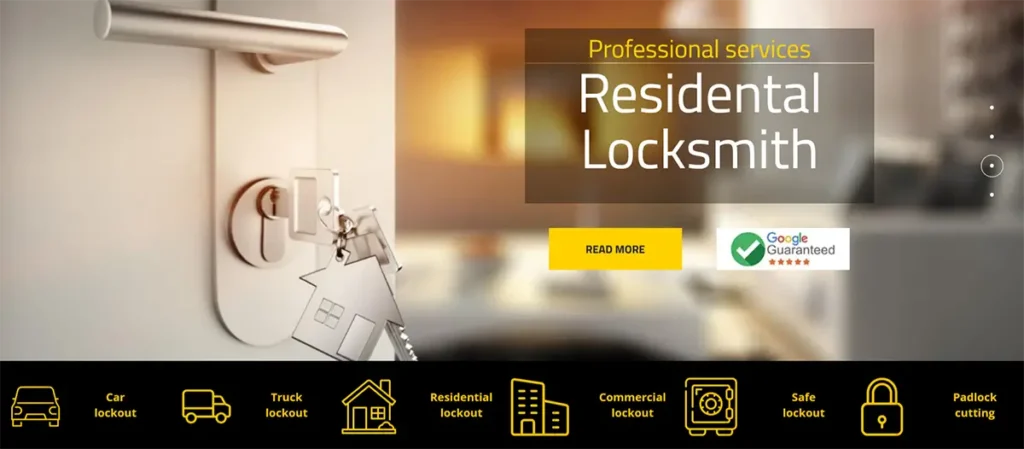
One of the projects we still remember involved a locksmith business in the United States. The website itself was not the hardest part.
The real challenge was getting the business through verification after its Google Business Profile had been suspended before our cooperation started. Because locksmith services are considered a high-risk category, the approval process took months instead of weeks.
That experience reminded us that a landing page or service website does not work alone. It needs to fit into a larger system: Google Ads, local visibility, business verification, trust signals, and a clear path to contact the company.
Mistakes We Keep Seeing Again and Again
Sometimes we review a landing page and immediately understand why it struggles to convert.
Not because the design is bad.
Not because the business lacks expertise.
Usually the issue is much simpler.
The page tries to do too much.
It talks about five different services.
It explains the company’s entire history.
It answers questions nobody is asking.
And somehow the main offer gets lost along the way.
We’ve also seen landing pages where visitors have to scroll halfway down the page before finding a phone number or contact form.
Others look great on a desktop monitor but become difficult to use on a smartphone.
Small problems like these can quietly reduce conversion rates for months or even years.
The frustrating part is that business owners often blame advertising when the real issue sits on the page itself.
5 Reasons Landing Pages Fail to Generate Leads
- visitors do not understand the offer within the first few seconds;
- the page tries to promote too many services at once;
- there are not enough trust signals for a new visitor;
- the mobile version feels weaker than the desktop version;
- the advertising message does not match the page content.
Landing Pages and Google Ads
Most landing pages we build are closely connected to advertising campaigns.
And honestly, that’s where their value becomes easiest to measure.
Every click costs money.
Sometimes a little.
Sometimes a lot.
If visitors arrive on a page that doesn’t answer their questions quickly enough, advertising budgets disappear surprisingly fast.
That’s why we spend time thinking about what happens after the click.
What information should visitors see first?
What concerns might they have?
What would make them trust the business?
What action should feel natural at that moment?
Those questions usually have a greater impact on results than another design trend or visual effect.
If you are planning to use paid search, our guide to Google Ads for beginners may help you understand how advertising, landing pages, and conversions should work together.
What We Usually Discuss Before Designing a Landing Page
Many people expect the first conversation to be about colors, layouts, or examples of websites they like.
That part comes later.
The first questions are usually different.
Who is your ideal customer?
Why do people choose your company?
What concerns do they have before reaching out?
What questions come up most often during sales calls?
The answers help shape the structure of the page.
After all, a landing page should not be designed around what a business wants to say. It should be designed around what potential customers need to know before taking action.
Once that foundation is clear, everything else becomes easier.
Can Landing Pages Rank in Google?
Yes.
We’ve seen landing pages rank well for specific services and local searches.
At the same time, it’s important to be realistic.
A single page can only cover so much information.
If a business wants to target dozens of services, locations, or search topics, a broader website structure usually creates more opportunities.
That’s one reason we often discuss long-term goals before recommending a solution.
Sometimes a landing page is exactly the right choice.
Sometimes it’s simply the first step.
We wrote more about this topic in our article on SEO for landing pages, including the situations where a one-page website can work in search and where its limitations become obvious.
Frequently Asked Questions
Let’s Talk About Your Project
Sometimes a landing page is the best possible solution.
Sometimes it isn’t.
We’d rather have an honest conversation at the beginning than recommend something that doesn’t fit your business.
Tell us about your goals, your service, or your advertising plans.
We’ll help you figure out whether a landing page is the right next step and what it should actually accomplish for your business.
