
Schema.org and Rich Snippets: How to Get Enhanced Results in Google Search
When you scroll through Google search results, you’ve probably noticed that some pages stand out more than others. Product pages may display prices and ratings. Recipe pages often show preparation times. Business listings can include additional information directly in search results.
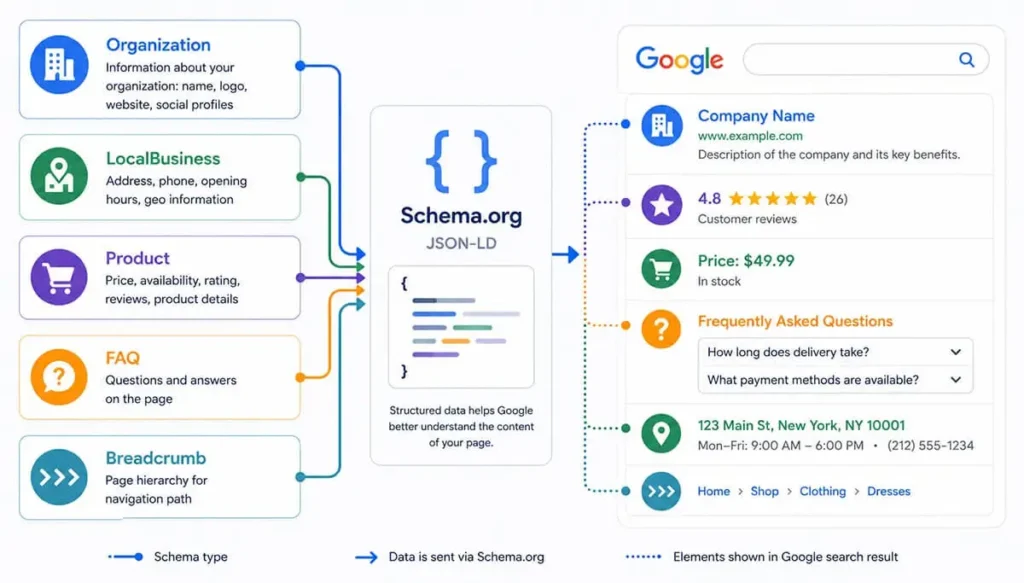
These enhanced search listings are known as Rich Snippets or Rich Results. They are powered by structured data markup, most commonly implemented using Schema.org.
In this article, we’ll explore what Schema.org is, how rich snippets work, which types of structured data are most useful, and why valid Schema markup does not always guarantee enhanced search results.
What Is Schema.org in Simple Terms?
Schema.org is a standardized vocabulary that helps search engines better understand the content of a webpage.
Think of it as an additional layer of information that explains what Google is looking at. Search engines can usually recognize text, images, and links, but structured data helps them determine whether a page represents a product, an article, an organization, a local business, a review, an event, or something else entirely.
Without Schema markup, Google has to interpret content based on context. With Schema.org, website owners can explicitly describe what each element represents.
The better Google understands a page, the greater the chance that information can be used in search results.
What Are Rich Snippets?
Rich Snippets are search results that display additional information beyond the standard title, URL, and meta description.
Depending on the type of structured data, Google may display:
- product prices and availability;
- ratings and reviews;
- breadcrumbs;
- FAQ sections;
- business information;
- event details;
- recipe information.
These enhancements help search results stand out and can improve click-through rates.
Common Schema Markup Types
Organization Schema
Provides information about a company, including its name, logo, website, and social media profiles.
LocalBusiness Schema
Particularly useful for local companies. It helps search engines understand a business’s location, contact information, and opening hours.
Product Schema
One of the most valuable markup types for eCommerce websites. It can provide information about pricing, availability, ratings, and customer reviews.
For eCommerce websites, Schema markup is only one part of technical optimization. Category structure, internal linking, page speed, and content quality remain equally important. We covered these aspects in more detail in our article Ecommerce SEO Optimization: Practical Recommendations for Online Stores.
Article Schema
Commonly used for blog posts, news articles, and educational content.
Breadcrumb Schema
Helps Google understand website hierarchy and can improve how navigation paths appear in search results.
FAQ Schema
Allows website owners to mark up frequently asked questions and answers.
While FAQ markup remains valid, Google displays FAQ rich results far less frequently today than it did a few years ago.
How to Add Schema.org to a Website
There are several ways to implement structured data:
- SEO plugins such as Rank Math or Yoast SEO;
- custom JSON-LD code;
- eCommerce plugins;
- custom theme development.
Google currently recommends JSON-LD because it is easier to maintain and less likely to interfere with page content.
How to Test Your Schema Markup
After implementation, structured data should always be validated.
The most commonly used tools are:
- Google Rich Results Test;
- Schema Markup Validator;
- Google Search Console.
These tools help identify errors, warnings, and unsupported markup types.
Does Valid Schema Always Produce Rich Results?
Not always.
One of the most common misconceptions about structured data is that valid markup automatically leads to enhanced search results.
In reality, Schema.org and Rich Results are not the same thing.
Schema markup helps Google understand products, organizations, articles, FAQs, and other entities. However, Google ultimately decides whether that information should appear as a rich result in search.
FAQ Schema provides a good example. Many websites continue to use valid FAQ markup, yet Google now displays FAQ rich results much less frequently than it did in the past.
This illustrates an important principle: structured data improves communication with search engines, but it does not guarantee a specific appearance in search results.
Why Rich Results May Not Appear
Even when Schema markup is technically correct, rich snippets may still not appear.
Some common reasons include:
- Google no longer prioritizes a specific rich result type;
- the page has not yet been reprocessed;
- the markup is valid but not considered useful enough;
- duplicate structured data exists on the page;
- overall site authority may influence visibility.
Even perfectly implemented structured data cannot compensate for broader SEO issues. Technical errors, indexing problems, weak content, or poor site architecture can still limit visibility in search results. If you’re troubleshooting rankings, you may also find our guide Common SEO Mistakes That Prevent Websites from Ranking useful.
Benefits of Schema Markup
- Helps search engines understand content more accurately.
- Improves eligibility for rich results.
- Can increase click-through rates.
- Supports voice search and AI-powered search experiences.
- Provides additional context for products, businesses, and content.
Conclusion
Schema.org has become an important part of modern technical SEO. It helps search engines understand content and creates opportunities for enhanced visibility in search.
At the same time, it’s important to remember that structured data and rich results are not the same thing. Valid Schema markup improves communication with Google, but the search engine still decides whether that information will appear in search results.
Users often form their first impression of a website before they even visit it. Search snippets, page titles, and descriptions all influence click-through rates. That’s one reason why both design and search appearance matter. We discussed this topic further in our article Interesting Web Design Facts Every Business Owner Should Know.
