
Why Google Ads Doesn’t Generate Leads: 8 Mistakes That Cost Businesses Money
Conversations like this have been a regular part of my work for more than ten years. Interestingly, when someone asks me to review their advertising, I rarely start by opening the Google Ads account. Instead, I ask to see the website, learn more about the business, find out who managed the campaigns before, and ask what results the owner expects. Experience has taught me that the answers to these questions are often far more important than any campaign settings.
Over the years I have come to one simple conclusion: Google Ads itself is rarely the main reason why a campaign fails to generate leads. Much more often, the real problem appears long before the first advertisement goes live, when the business owner makes the first strategic decisions. What makes this interesting is that almost every one of those decisions sounds perfectly reasonable.
“Why create ten campaigns if one campaign can advertise everything?”
“Why pay for ongoing management if the campaign has already been set up?”
“Google recommends these changes itself. Why would I need another specialist?”
“Let’s lower the cost per click. If we can pay less, why spend more?”
I’ve heard each of these arguments dozens of times. None of those business owners wanted to make a mistake. They were simply trying to save money, speed things up, or avoid paying for something that didn’t seem necessary. That’s why I no longer divide marketing decisions into “right” and “wrong.” In business, the same decision can be an excellent choice for one company and an expensive mistake for another.
I remember one of the first projects that made me realize this. A business owner approached me with a very niche product — dry yeast. Competition was almost nonexistent, search volume was low, and after looking at the numbers I suggested investing in SEO instead of Google Ads. My reasoning was simple: within a few months the website could rank at the top of Google organically, making paid advertising almost unnecessary.
The client listened carefully but made a different decision. He chose Google Ads, not because it promised better long-term results, but because paying a small monthly advertising budget felt easier than investing a larger amount in SEO upfront. At the time, that decision worked surprisingly well. His ads consistently appeared at the top of Google, clicks were inexpensive, and the monthly budget lasted for weeks. Years later, however, the market changed. New competitors entered the niche, click prices increased, and advertising became significantly more expensive. Looking back, I still believe SEO would have been the stronger long-term investment, but I also understand exactly why he made the choice he did.
This article is not about blaming Google Ads, nor is it about blaming business owners. It’s about eight decisions that often seem perfectly logical at first but gradually become the real reason why advertising fails to deliver the results people expect.
There Is No Universal Google Ads Strategy
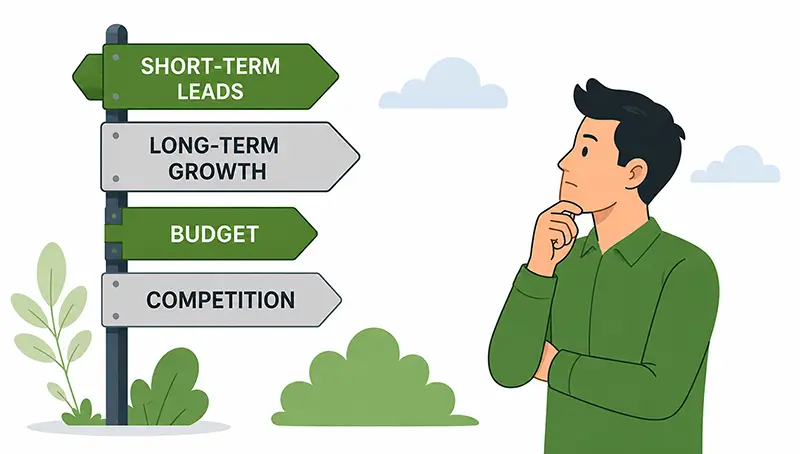
If someone asked me ten years ago whether Google Ads or SEO was the better investment, I probably would have tried to give a straightforward answer. Today I wouldn’t. Experience has shown me that the right strategy always depends on the business itself. The size of the market, the level of competition, customer behavior, available budget, and long-term goals all matter. The same approach can produce excellent results for one company and disappoint another.
The story about the dry yeast business is a good example. From a purely strategic perspective, I still believe SEO would have been the smarter long-term investment. After reaching the top organic positions, the company could have continued receiving highly targeted traffic without paying for every single click. However, the owner saw the situation differently. Investing a significant amount in SEO all at once felt risky, while spending a relatively small amount on advertising each month seemed much more comfortable.
For several years, that decision actually worked. Competition remained low, clicks were inexpensive, and the campaigns generated enough enquiries to support the business. Only later, when more competitors entered the market and advertising costs increased, did the long-term value of SEO become much more obvious.
I’ve seen the opposite situation as well. Sometimes a business enters a highly competitive market where waiting six or twelve months for SEO results simply isn’t an option. The company needs customers immediately to keep operating. In cases like that, Google Ads is often the only realistic way to start generating enquiries while the website gradually builds its organic visibility.
This is why I never recommend Google Ads or SEO as a universal solution. The real question isn’t “Which channel is better?” It is “Which channel makes the most sense for this particular business at this stage of its growth?” Every time I hear someone say that “SEO is dead” or “Google Ads is a waste of money,” I know they are trying to solve a business problem with a universal answer. In reality, successful digital marketing rarely works that way.
The best results almost always come from choosing the right strategy for the current situation rather than blindly following what worked for someone else. If you’re still unsure which strategy is right for your company, you may also find our article about SEO for small businesses helpful. It explains when investing in long-term organic growth can become more profitable than relying entirely on paid advertising.
The Cheapest Click Isn’t Always the Best Deal
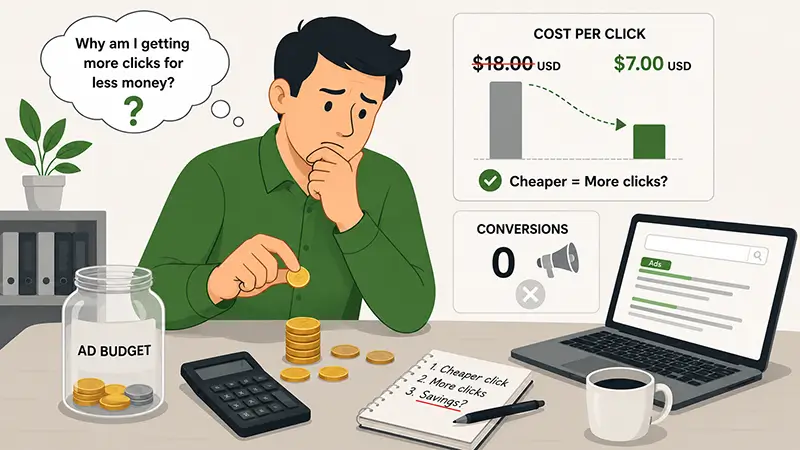
One conversation has repeated itself throughout my entire career. A business owner opens the campaign statistics, notices that some clicks cost significantly less than others, and asks:
At first glance, the logic seems flawless. Lower costs should mean better profitability. The problem is that Google Ads doesn’t sell clicks — it sells opportunities to appear in front of potential customers. And not every opportunity has the same value.
Imagine two people searching for the same type of service. One performs a highly specific search during business hours, is ready to make a decision, and clicks on one of the first ads at the top of the page. The other searches late at night, scrolls to the bottom of the results, clicks on an ad almost out of curiosity, and leaves the website a few seconds later. Both actions count as clicks. Both reduce your advertising budget. But they are far from equal in terms of business value.
This is something many advertisers overlook when they focus exclusively on lowering CPC. A cheaper click often means accepting less competitive auctions, weaker ad positions, or search queries that are simply less likely to convert. On paper, the campaign looks more efficient because the average cost per click has gone down. In reality, the number of enquiries may decline just as quickly.
That doesn’t mean lower CPC is always bad. In some industries, reducing costs without sacrificing quality is absolutely possible. The important question is whether cheaper traffic still brings qualified prospects. I’ve never considered low CPC to be a goal by itself. For me, the real objective is much simpler: I’d rather pay twice as much for a visitor who becomes a customer than receive hundreds of inexpensive clicks that never generate a single enquiry.
In the end, businesses don’t earn money from cheap clicks. They earn money from profitable customers.
“Just Create One Campaign”
One of the most common requests I hear sounds surprisingly reasonable.
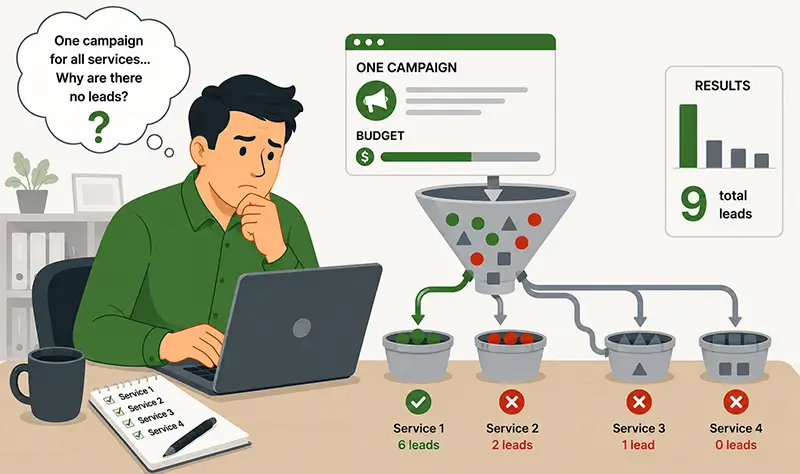
From the business owner’s perspective, this approach saves both time and money. Fewer campaigns mean less work during setup and lower management costs later on. Unfortunately, Google Ads doesn’t work that way.
To understand why, imagine someone searching for automatic transmission repair. They click on your advertisement expecting to find exactly that service, but instead arrive on a homepage listing twenty completely different services — oil changes, brake repairs, diagnostics, tire replacement, engine repairs, electrical work, and much more. The information they need is probably there somewhere. The question is whether they’ll spend the next few minutes looking for it. Many won’t.
Google notices this behavior as well. Its goal is not simply to display advertisements but to connect users with the most relevant answer to their search. That’s why campaigns perform better when the keyword, the ad copy, and the landing page all support the same intent.
This doesn’t only improve user experience. It also improves campaign performance. Visitors find the information they were looking for much faster, conversion rates increase, and Google gradually rewards the campaign with a higher Quality Score. In many cases, that even leads to lower advertising costs over time.
Ironically, trying to save a few hours during campaign setup often becomes much more expensive later. The campaign may continue receiving clicks, but every click costs more than it should because the structure was never designed around the user’s intent. I’m not suggesting that every business needs dozens of campaigns. What matters is creating a structure that reflects the way potential customers actually search for your services — not the way it’s most convenient to organise your advertising account.
The same principle applies when planning a website. A clear structure with dedicated landing pages not only improves user experience but also makes advertising significantly more effective. If you’re planning a new project, you may also want to read our guide on website development costs and the decisions that influence long-term marketing results.
Google Gives Great Recommendations — But It Doesn’t Know Your Business
Google Ads has become incredibly smart over the years. The platform constantly suggests improvements, highlights opportunities, and even estimates how certain changes might affect campaign performance. For someone managing advertising for the first time, those recommendations can feel reassuring. After all, if Google itself suggests making a change, it must be the right thing to do.
In practice, things are rarely that simple. I’ve worked with business owners who followed almost every recommendation shown in the account. They switched bidding strategies, expanded keyword matching, increased budgets, and enabled new campaign features simply because the platform encouraged them to do so. When the expected results failed to appear, they were genuinely disappointed. Their conclusion was straightforward: if Google suggested these changes, why didn’t they work?
The answer is surprisingly simple. Google understands advertising exceptionally well, but it doesn’t understand your business. It doesn’t know which enquiries are genuinely valuable, how your sales process works, what your profit margins look like, or which customers you would rather avoid. Its recommendations are based on statistical patterns across millions of accounts — not on the unique circumstances of your company.
That doesn’t mean Google’s advice should be ignored. Quite the opposite. I review those recommendations regularly, and some of them are genuinely useful. The mistake is treating every suggestion as an instruction that must be implemented immediately.
Before accepting any recommendation, I usually ask myself one question: Will this help achieve the client’s business goals, or will it simply improve Google’s advertising metrics? Those are not always the same thing. Sometimes the best decision is to apply Google’s recommendation exactly as suggested. Sometimes it makes sense to adapt it. And occasionally, the right decision is to ignore it completely.
Experience has taught me that successful Google Ads management isn’t about collecting a perfect optimisation score. It’s about making informed decisions based on real business objectives rather than blindly following automated advice.
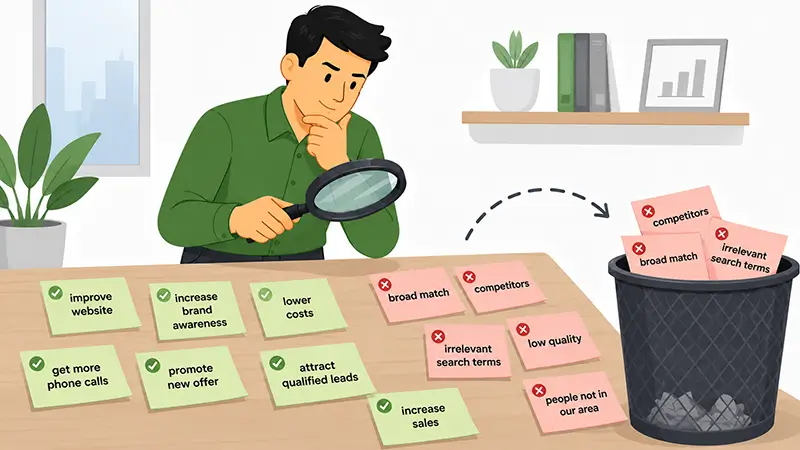
Review Your Search Terms Regularly
There are certain habits I’ve developed over the years that I follow in almost every Google Ads account. Not because Google’s documentation tells me to, but because experience has proven their value time and time again.
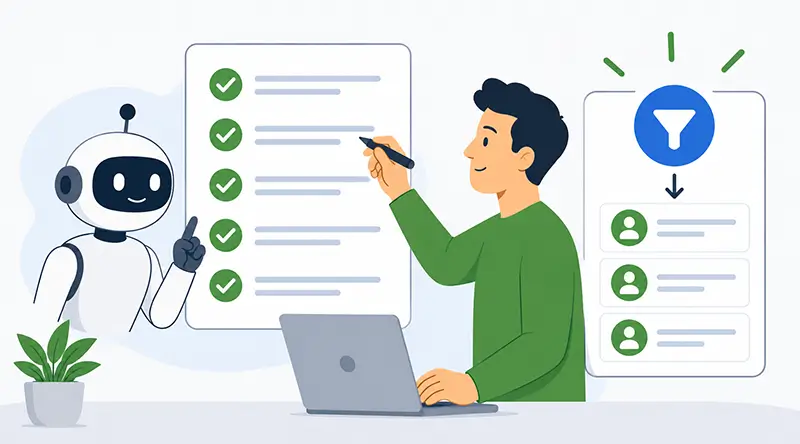
One of those habits is reviewing the Search Terms report. When a campaign is brand new, I may check it every day. Once performance stabilises, once a week is usually enough. What I never do is stop looking altogether.
Every now and then someone asks me a perfectly reasonable question:
Because people don’t always search the way we expect them to. Before launching a campaign, we spend time researching keywords that seem logical and relevant. Then real users arrive, and suddenly we discover dozens of search phrases we never anticipated. Some of them become valuable new keyword ideas that help expand the campaign. Others reveal something completely different — they show where the ads should never have appeared in the first place.
That’s why my negative keyword list is never truly finished. Search behaviour changes. New trends emerge. Google’s matching systems evolve. If nobody reviews the actual search terms, irrelevant traffic quietly begins consuming more and more of the advertising budget.
Many advertisers focus almost entirely on campaign settings while paying very little attention to what people are actually typing into Google. In my experience, that’s one of the easiest ways to waste money without even noticing it.
A few minutes spent reviewing search terms each week can often save far more than hours spent adjusting bids or rewriting advertisements. It’s one of the simplest maintenance tasks in Google Ads, yet it consistently delivers some of the biggest long-term improvements. Search term analysis is closely connected with keyword research. If you’d like to avoid common mistakes before launching a campaign, you may also find our guide to keyword research mistakes helpful.
Great Advertising Can’t Save a Weak Website
Every now and then I receive a call from a business owner who sounds genuinely frustrated.
When I hear something like that, I don’t start by looking at the advertising account. I ask to see the website.
One case still stands out in my memory. It was a company operating in a highly competitive industry. Their monthly advertising budget was substantial, yet not a single enquiry had come through. The owner was convinced the problem had to be the campaigns themselves.
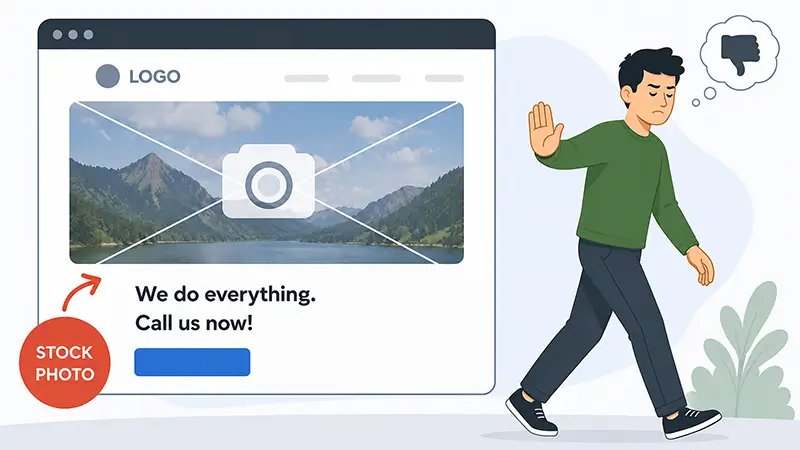
The website told a different story. It consisted of just a few pages. Each page featured a generic stock photo and a couple of short sentences saying, “We’re professionals. We offer high-quality services. Contact us today.” There were no detailed service descriptions, no examples of previous work, no customer reviews, and nothing that explained why a visitor should choose this company over dozens of competitors.
The advertising wasn’t the biggest problem. The website simply gave potential customers no reason to trust the business. This is one of the most common misconceptions I encounter. Many people believe Google Ads is responsible for convincing visitors to become customers. It isn’t.
Advertising has only one job — to bring the right people to your website. Once they arrive, the website has to do the rest. It needs to answer questions, build confidence, explain the service, and make contacting the company feel like the obvious next step. If the website fails at that task, increasing the advertising budget rarely changes the outcome. In fact, it often makes things worse, because more traffic simply means more people leaving without taking any action.
Over the years, I’ve advised several business owners to postpone launching Google Ads until their websites were ready. At first, that advice wasn’t always popular. Some expected advertising to compensate for an unfinished website. Surprisingly, many of those conversations eventually led to website improvements or complete redesigns. Only after strengthening the site itself did advertising begin delivering consistent results.
Google Ads can bring visitors. It cannot create trust where none exists.
Google Ads Is Never “Set and Forget”
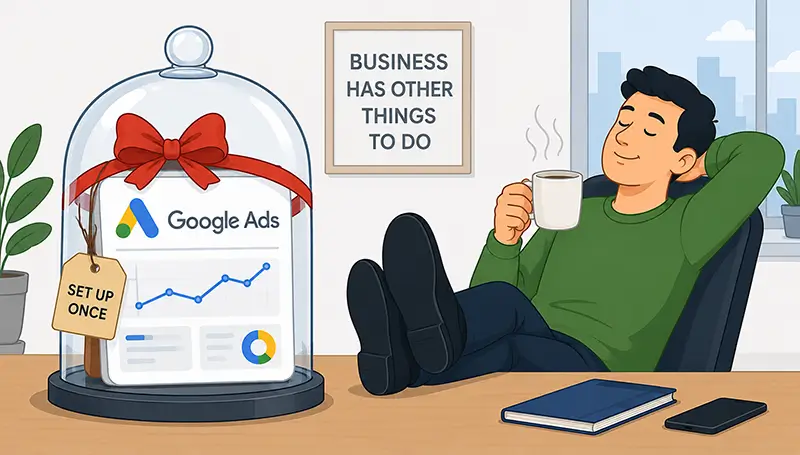
One of the biggest myths surrounding Google Ads is that successful campaigns can simply run on their own forever. I understand why people think that. Once a campaign has been carefully planned, keywords selected, ads written, conversion tracking configured, and everything appears to be working, it feels natural to assume the difficult part is over.
In reality, that’s usually when the real work begins. Search behaviour changes. Competitors adjust their bids. New businesses enter the market. Google introduces new campaign features, modifies its algorithms, and changes the way ads are displayed. Even seasonal trends can significantly affect campaign performance.
A campaign that delivered excellent results six months ago may gradually become less effective without anyone noticing. This doesn’t necessarily happen because something is broken. It happens because the environment never stops changing.
That’s why I don’t see Google Ads management as a one-time technical task. I see it as an ongoing process of observation, analysis, and continuous improvement. Sometimes only small adjustments are needed — reviewing search terms, refining negative keywords, updating ad copy, or testing a different landing page. Individually, these changes may seem insignificant. Together, they often determine whether a campaign continues generating profitable leads or slowly loses its effectiveness.
Whenever someone tells me:
I usually smile. That’s a little like saying a garden no longer needs attention because all the flowers have already been planted. Without regular care, even the healthiest garden eventually begins to decline. Google Ads works much the same way.
A New Website Is Almost a New Beginning for Google Ads
Many business owners believe that replacing an old website is a purely technical project. Once the new design goes live, they expect everything else to continue working exactly as before. Google Ads doesn’t always see it that way.
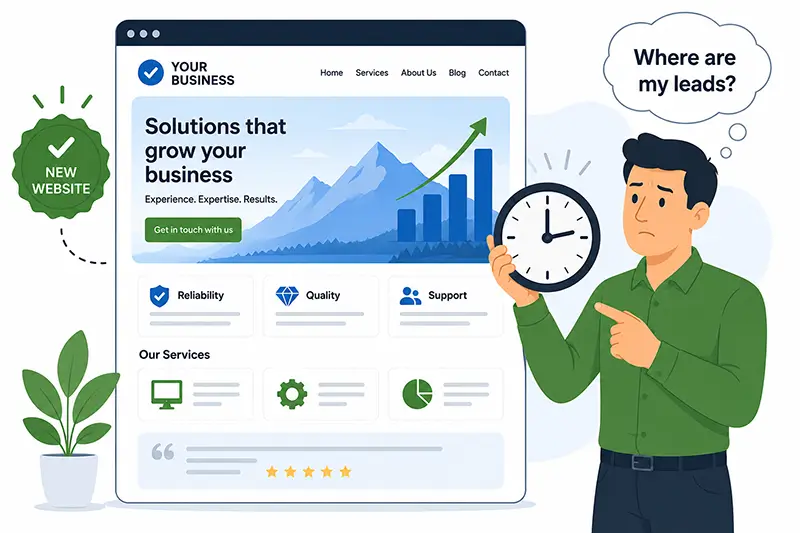
I remember one client whose advertising campaigns had been performing consistently for nearly two years. The account had accumulated valuable historical data, Google’s algorithms had learned which users were most likely to convert, and the cost per lead remained stable. Then the company launched a completely new website.
The advertising account stayed the same. The budget stayed the same. The products and services stayed the same. Yet campaign performance changed almost overnight.
The reason wasn’t difficult to understand. The new website introduced different landing pages, new conversion actions, updated page structures, and redesigned user journeys. From Google’s perspective, many of the signals it had relied on for optimisation had suddenly changed. The system needed time to collect fresh data, understand the new conversion patterns, and optimise campaigns accordingly.
For the business owner, however, the situation felt very different.
It’s a perfectly reasonable question. The problem is that Google Ads doesn’t instantly adapt to major changes. Launching a new website often means launching a new learning phase as well.
This doesn’t mean advertising should be paused or abandoned. It simply means expectations need to remain realistic. During this period, campaigns often require closer monitoring, careful adjustments, and a bit of patience while Google’s algorithms adapt to the new environment.
The mistake isn’t building a better website. The mistake is expecting everything to work exactly the same on day one. A successful website launch doesn’t mark the end of optimisation. In many ways, it’s the beginning of the next stage.
Conclusion
When I first started working with Google Ads, I believed success depended mainly on understanding the platform itself. Learning every setting, mastering bidding strategies, choosing the right keywords, and writing effective ads seemed like the most important skills.
Today I see things differently. Technical knowledge is still essential, but experience has taught me that successful advertising depends far less on individual settings than most people imagine. Much more often, the outcome is determined by decisions made long before the first campaign goes live.
Is the website ready to convince potential customers? Does the campaign structure reflect the way people actually search? Is the chosen strategy appropriate for this particular business rather than copied from someone else’s success story? Is the business owner prepared to improve the campaign continuously instead of expecting perfect results after a single setup?
These are the questions I ask far more often today than I did ten years ago. During that time I’ve worked on dozens of projects. Some campaigns produced excellent results almost immediately. Others required months of testing, refinement, and patience before they became profitable. Every one of them taught me something valuable.
If I had to give just one piece of advice to a business preparing to launch Google Ads today, it would be surprisingly simple.
Don’t start with Google Ads.
Start with your business.
Everything else becomes much easier once that foundation is in place.
